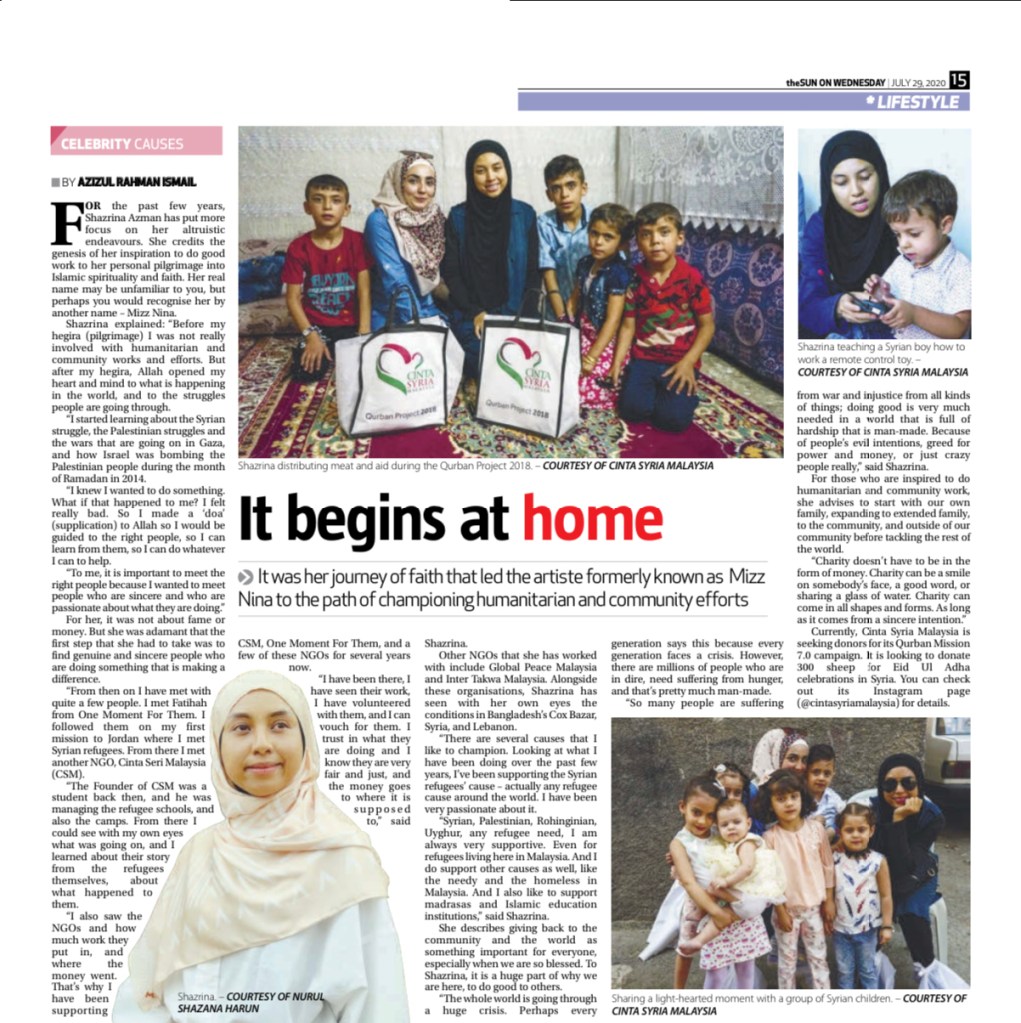
This interview took some gymnastics to set up. She is a very busy person and I had to go through a PA. It took some convincing, but finally, the whole thing was done through voice mail. Of course.
Honestly, I don’t think I would have gotten the interview if it were not for a mutual contact.
Because it was not a conversation, I had to make my questions broad. Thankfully she is a talker. That was a blessing. I only found the lead to the story about halfway through the recording.
Transcribing a recording is a chore. I could just write the story as she says tells it, but that usually results in a lazy story. To make a good story, I need the whole thing laid out in front of me, mould them into blocks, restacked them, and hold them together with mortar.
The unique challenge that I had with writing this story was her use of language. She is a someone who has rediscovered her faith, and a Muslim who outwardly displays their faith talks a certain way. Praises to God peppered her sentences like ‘um’ and ‘ah’ would.
I wanted to respect the way she expresses herself, but I could not punctuate sentences with Arabic translations. So, I decided I used Muslim-English and borrowed Biblical terminology to keep the core of her story. To not lose that religious tone. But, at the same time, skimmed off the flourishes.
That is when I learned that hegira is a word. A legitimate English word. Go ahead, check a dictionary. Those who use the word would most probably have seen it written as ‘hijrah’. They have the same meaning, but the latter is how we spell the Arabic word in Malay.
What makes this difficult in Malaysia is a lot of people who are not used to separating cultures from religions. So much so that effects language. But it is changing. For example, the Malay terms Aidilfitri, Aidiladha, and Hari Raya is widely used, even in English. Now the Arabic/Muslim-English term Eid-al-Fitr and Eid-al-Adha is beginning to gain traction.
Read the story here.
 Azizul Rahman Ismail