
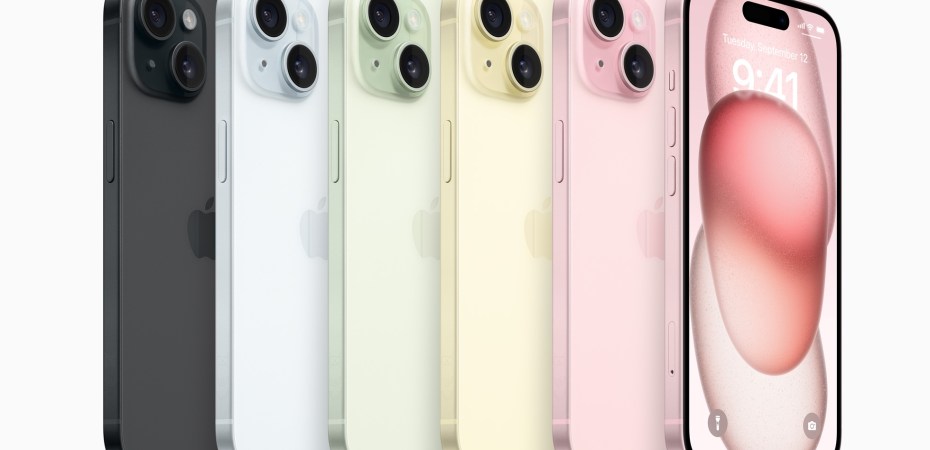
For the iPhone 15 devices, Apple took the A16 Bionic, Dynamic Island, and the 48MP primary camera (with 2x optical zoom) from the iPhone 14 Pro devices and made them more accessible. Then it added USB-C, upgraded the Ultra Wideband, and wrapped it all in a gorgeous, durable design that is just different enough to make previous-generation accessories obsolete.
Pricing and Availability
Apple listed the starting prices for the 6.1-inch iPhone 15 and 6.7-inch iPhone 15 Plus at RM4,399 and RM4,899. It will be available in pink, yellow, green, blue, and black in 128GB, 256GB, and 512GB storage capacities.
In Malaysia, the devices are said to be available on Friday (September 29).
The floor prices for the iPhone 15 are RM200 more than the iPhone 14 when it launched. But it’s still way less than an iPhone Pro, and the value is still excellent.
For accessories, the FineWoven Wallet with MagSafe and FineWoven Case with MagSafe accessory will both be available for RM279. The Clear Case will be available for RM239, and the Silicone Case with MagSafe will be available for RM239. All in new colours.
However, I’m sceptical of how hygienic and durable the FineWoven material is.
Design Matters
As is, the iPhone 14 devices look gorgeous and are anything but fragile. Like the iPhone 14 devices, the Super Retina XDR display on the iPhone 15 and iPhone 15 Plus is protected by Ceramic Shield. But, the back is a strengthened, matte colour-infused glass, and the surrounding band is a new contoured edge aluminium enclosure.
When looking at the fine print in Apple’s statement, it said, “When measured as a standard rectangular shape, the screen is 6.06 inches (iPhone 15) or 6.68 inches (iPhone 15 Plus) diagonally. The actual viewable area is smaller.”
It also said: “iPhone 15 and iPhone 15 Plus are splash-, water-, and dust-resistant. They were tested under controlled laboratory conditions and have a rating of IP68 under IEC standard 60529 (maximum depth of 6 metres for up to 30 minutes).”
To be safe, Apple added that the splash, water, and dust resistance are not permanent, and resistance might decrease due to normal wear.
One Cable To Rule Them All
Now that the iPhone 15 and iPhone 15 Plus (and AirPods Pro 2) use USB-C, the devices can also double as a power bank for charging Apple Watch and AirPods.
It’s a welcomed change. How compatible the iPhone 15 and iPhone 15 Plus to non-Apple chargers and cables is yet to be seen.
As for file transfer speeds, I don’t think it is a concern for most users. But what would be helpful for some users is the ability to output 4K at 60 fps HDR video output using a USB‑C Digital AV Multiport Adapter. However, I wonder if it would work with a USB-C to HDMI cable without the adapter.
Also, both models support MagSafe and future Qi2 chargers for wireless charging. So, not all iPhone 14 charging accessories are incompatible. I guess that’s the advantage of using wireless charging.
On a side note, I expect to see a USB-C on the next AirPods Max this year.
Three Focal Lengths, Finally
For the first time, the iPhone 15 and iPhone 15 Plus give the option of three zoom levels —0.5, 1.0, and 2.0— on a non-Pro iPhone and only using two cameras. It does this using a neat trick with the 48MP sensor. It shoots at 48MP but produces a 24MP image by default by doubling the sensor information. It results in better-looking photos that are more manageable in size. To zoom, it crops into 24MP without losing quality. It uses the other camera for the wide shots and macro.
Based on my experience with the iPhone 14 Pro, the photo quality on the iPhone 15 and iPhone 15 Plus should be excellent. Whenever I think about getting a mirrorless camera, I look at shots I took with the iPhone 14 Pro Max, and the desire goes a little.
But those used to Chinese phones would find it an acquired taste as iPhone photos tend to look natural. This could be remedied using the Photographic Style setting.
Now Everyone Gets An A16 Bionic
The Bionic A16 has “proven, powerful performance”. The A16 Bionic in the iPhone 15 and iPhone 15 Plus has more of everything and can do more compared to the A15 Bionic of the iPhone 14 and iPhone 14 Plus, but uses less power.
I haven’t found anything that the A16 Bionic can do in everyday use that the A15 Bionic cannot. Occasionally, when I get into high-resolution video editing or demanding gaming, I notice that the A16 Bionic (iPhone 14 Pro) is faster than the A15 Bionic (iPhone 14). With the ceiling raised, expect to see apps that take advantage of the extra power.
What the iPhone 15 series has over the iPhone 14 and iPhone 14 Pro series is the new Ultra Wideband. It improves Find My and enables Precision Finding for Find My friends. It should make finding misplaced Apple devices and AirTags more accurate.
More Cloud!
Starting Monday (September 18), iCloud+ will offer two new plans: 6TB for RM129.90 per month and 12TB for RM269.90 per month.
I love the service and recommend it. It is more than just private cloud storage; I also use it to transfer files to a PC or for work. The Hide My Email feature is a must-have in an environment where every service demands an email address to spam. I always use it to generate an email address that I can quickly delete after getting the initial confirmation.
However, the 6TB and 12TB options, although nice to have, are way too big for most users. My family and I barely dented the 2TB I subscribe to.
About that iOS17
iOS 17 will be available as a free software update on Monday, September 18. It’s coming to iPhone SE 2 and later devices. This includes the iPhone X series.
It brings a lot of new software features, some of which will be exclusive to the iPhone 15 series, like Precision Finding for Find My Friends.
Is it better for the environment?
Apple said it prioritises clean electricity across the supply chain and designs products with recycled and other low-carbon materials. The list is impressive.
The iPhone 15 and iPhone 15 Plus is said to use 100% recycled cobalt, 100% recycled copper, 75% recycled aluminium, 100% recycled rare earth elements, and 100% recycled gold in its construction.
Although not yet plastic-free, the packaging is said to be over 99% fibre-based.
Additionally, Apple would no longer use leather in new products, including iPhone accessories. Instead, it’s switching to the microtwill fabric it calls FineWoven, made from 68% recycled materials.
That’s all good if the devices stay functional, usable and relevant for longer.
Thoughts
Although some technology used in the iPhone 15 and iPhone 15 are tried and tested, what’s new is compelling. Is it RM200 worth of new? I’d say yes, for most people.
https://www.apple.com/my/newsroom/2023/09/apple-debuts-iphone-15-and-iphone-15-plus/
 Azizul Rahman Ismail