
It all started with the need for a simple game to pass the time while my friend and I hung out together. The game needed to be easy, straightforward, and portable. That’s how a deck of plastic playing cards became part of my everyday carry. The game was Rummy.
In Rummy, with two players, each player has a hand of 10 cards (8 cards for three or four players). On each turn, you must draw a card from either the deck or the discard pile and then discard a card. The goal is to play all your cards by forming sets: a straight flush (three cards in sequence with the same suit), three of a kind, or by adding a card to an already played set. Also, remember that the Ace is considered low. This was the simplest version of the game.
However, some people found Rummy too simple for gambling, which led to many variations that are far more complex.
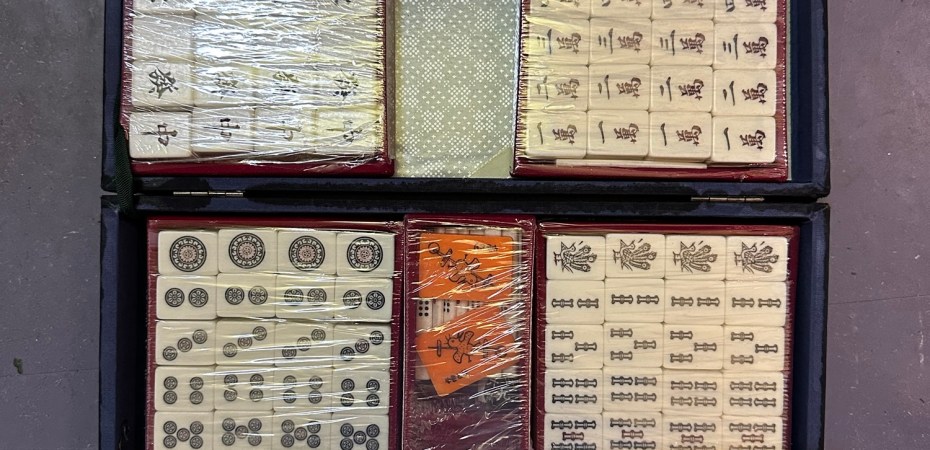
Then, I decided to try Mahjong and discovered that its story was similar to that of Rummy. A typical Mahjong set has 144 tiles, but you can play a basic game with just 136 tiles. All you need are the three suit sets (dots, bamboo, and characters) and the honour tiles (the four cardinal directions and the three dragons).
In Mahjong, with two to four players, each player starts with a hand of 13 tiles. On each turn, you draw a tile from the wall (deck) and then discard one. If you can form a set from a tile that was just discarded, you may draw it instead, revealing the sets you form. The goal is to create and reveal four sets of three tiles (either three of a kind or a three-tile straight flush) along with a pair.
Again, some found this game too simple for gambling, resulting in many variations, the most complex of which is Riichi Mahjong (or Japanese Mahjong).
Eager to try Mahjong, I picked up a set of Japanese Mahjong tiles from a second-hand shop for RM30. These tiles are about the size of a three-by-two Lego brick and include some special tiles (which I don’t plan to use). Otherwise, they are quite similar to the larger Chinese Mahjong tiles.
 Azizul Rahman Ismail