
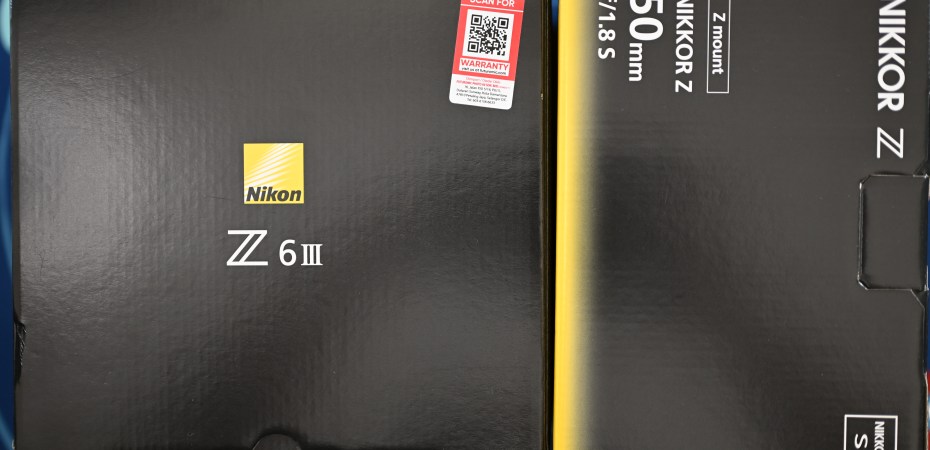
After decades of taking photos with various types of cameras, I convinced myself that I want a full-frame digital camera with a 50mm lens. I also convinced myself that the best setup I could afford was a Nikon Z6 III paired with a Nikon NIKKOR Z 50mm f/1.8 S.
It started with my budget. Love it or hate it, the budget is the ultimate decision maker, and it demands honesty. I set a budget; I might miss some features by doing so, but I had to stick to it to avoid accumulating debt.
Full-frame cameras were expensive. Cameras with smaller sensors could produce images that are just as good at a cheaper price. Nevertheless, the lenses I wanted were in full frame and the photography universe, from its language to its engineering, centres on the 35mm film (full frame), which was easier to understand.
Buying the latest top-of-the-line phone for its camera, which would also be less expensive, was not an option. I wanted to capture memories as I see them through the lens, instead of having them processed through an algorithm. I was wary of digitally “enhanced” photos.
I could have saved even more money by buying a (better) film camera. It would have fulfilled all of my requirements. However, I wanted to do more with my photography; I wanted to explore photojournalism. And that requires speed.
Of the three camera makers known for their full-frame cameras, I chose Nikon because I had three broken Canon film SLRs, and Sony seemed to have run out of its Minolta-powered steam. I also have some nostalgia for Nikon.
I decided to get a mirrorless camera instead of a DSLR (which would have been more affordable too) based on the advice of news photographers. They said that it was best to get something that was future-proof and more durable.
It took me a little too long to realise that I liked 50mm lenses for their large aperture. I also liked how far I could be from a subject to take a good photo with it, neither too close nor too far.
There are four 50mm Nikon NIKKOR Z lenses to choose from. My rule was to pick the one with the biggest aperture that fits the budget. Since the NIKKOR Z MC 50mm f/2.8 has the smallest minimum aperture and the NIKKOR Z 50mm f/1.2 S would cost as much as a new camera, these two were easily eliminated.
I was left with the f/1.8, which was commonly the cheapest, and the f/1.4, which should be a step up in lens brightness and speed. But the thing was Nikon equalised the two lenses by making the NIKKOR Z 50mm f/1.8 S sharper, the NIKKOR Z 50mm f/1.4 has more character, and priced both of them shoulder to shoulder. After conducting some research, I chose the f/1.8 S lens for its superior image quality.
Once I had decided on the system (Nikon Z) and lens (50mm f/1.8 S), it was time to choose the actual camera. Again, Nikon did not make it easy.
My first pick was the Z5II. Nikon’s latest entry-level camera had contemporary features and a few added extras. It turned out that the cheapest configuration, body only, was sold out. Additionally, none of the pack-in lens options was a 50mm.
I did consider switching brands. Still, none of their options fit as well as the Z5II did. Then someone suggested that I take a look at the slightly older and more advanced Z6III. It was more expensive.
What levelled the scales for me was the Z6III’s video capabilities and advanced features, such as a physical shutter and a fast, partially stacked sensor. What tipped the scales was the discount I could get in addition to a free battery and memory card. If I purchase these essential accessories for the Z5 III, the total cost would be similar or slightly lower than the Z6 III’s discounted price. The choice seemed obvious.
All that said, there are many reasons why you should not purchase a Nikon Z6 III, even if you have the money for it. Chiefly, if your phone or a newer one can do a good enough job of it, use the phone. Especially when it involves video.

If you still want a dedicated camera, start with the cheaper options. Consider compact digital cameras, especially older models with CMOS sensors, for their compact size and affordability. They also take photos with a lot of character.
If you need a camera with interchangeable lenses, consider models featuring micro Four Thirds or APS-C-sized sensors. They have limitations that you can ignore; they are cheaper and more portable when compared to full-frame cameras.
If you want to get a film camera, consider modern SLR models instead of vintage ones. Skip the compacts and range finders. Modern film SLR cameras are more affordable, capable, and less prone to problems. Remember that you will need money to buy film and have it developed.
Otherwise, if you are still set on getting a full-frame interchangeable lens camera, choose a brand and select its latest entry-level camera. If all brands are equally accessible to you, pick the one with the lenses that you like.
While I recommend the Z5 II becasue it is better suited for folks who don’t make money with their cameras. I am still satisfied with the Z6 III. Although most of its professional features were wasted on me, I want my skills and knowledge to fill the gap. In the meantime, I aim to acquire two more lenses: one wider, similar to a lens on smartphone cameras, and another narrow, like a particular legendary old lens.
 Azizul Rahman Ismail